
One size fits all on Flickr.
One size fits all on Flickr.
Today the inaugural Brigade Captains were announced as part of the Code for America Brigade program. I’m proud and nervous to be the first Captain of an Oakland brigade- Open Oakland. I think we may well have a co-captain very soon too. There’s simply so many things a CfA Brigade can achieve in Oakland and a lot of work to coordinate and plan it out.
The official version is here:
“Brigade is all about recognizing and supporting the volunteer efforts of civic minded technologists throughout the country who want to contribute to the civic web and code for America where they live. Our aim at Code for America is grow, strengthen, and connect the network of people involved in doing so. We have two mechanisms for doing that.
The Brigade Captains program is our structured, facilitated, ideal model for local brigades and brigade leadership. Captains are enlisted for a one year commitment to develop, publish, and execute a year-long plan for their cities based on our core activities. Captains are hold regular meetings of their brigades, host events in their cities, and share the stories of their accomplishments.”
If you have an interest in open government, open data, civic innovation and have skills to help us move this work in Oakland please join the Brigade site, then email openoakland@googlegroups.com to connect in with us- our first meeting will be next week. Brainstorming, intros, plans and projects. Beer too.
Fledgling site for Open Oakand
Here’s the rest of the captains/brigades:
I had the chance to see a preview today of the Detroit team’s app called LocalData today- part of the Code for America program. Once again it’s very exciting to see what a team of outside designers, technologists, planners and data geeks can do in the right environment and with the right pretext. For me this is a liberating and exciting trend. Having come up with ways to do the exact same thing in my work I’m painfully aware of how clunky and onerous it is to set up the tools to conduct and manage and publish survey data- our city has been surveyed to death and the results are typically in the filing cabinets of nonprofits and government departments. useless.
Take a quick look at the video showing what LocalData is and does and read on..
LocalData Demo by Code for America from CfA Detroit on Vimeo.
These kinds of newly developed tools would have made a huge difference in the development and implementation of our last major community survey project with a team of high schoolers from Youth UpRising in East Oakland (full article here).
Typically if a community group, organizing group or public agency want’s to collect data they need to call some experts. And we don’t come cheap typically. When we started this project the ask was to help their youth survey their community, so we helped them to identify the focus- park conditions and safety, property conditions and healthy food availability.
Paper sucks, in most instances. We ended up choosing to purchase some discounted Trimble Juno GPS units and got donated ArcPad software from ESRi along with ArcGIS Mobile that came with our server licenses. At the time (mid 2010) the new Mobile software was terrible, super unstable on any setup we tried, bugs the development team couldn’t solve, so out went the more elegant interface and in went an ArcPad project. Trouble is no-one else on our team had had the joy of working with this product before, so fun for me… The devices were loaded with all the parcel data for their community and a bunch of survey screens to gather condition data- we copied a property survey done in another major city to have some form of data standard in the end. Let me just add that even for a seasoned GISP the learning curve and setup time for this app is not small or pretty.
The units froze in the field, crashed, lost data and all kinds of fun that frustrated the students and added time and cost to managing the project. I don’t think we had more than three students actually like using the device/app. But we got out data for the parks and for every property in the tract. 1,000 parcels surveyed. Every park in East Oakland surveyed (there we used a survey template from a HEAL group in Richmond to again try to get some comparable data in our region). But all the data had to be managed, processed and mapped by our team of researchers.
The finished poster of the project is below. The photos we had to take later with a real camera as the Juno devices would only provide ArcPad with a 160×120 image, awesome, that’s like 0.01 megapixels?? Another reason why a smartphone solution just kills it. Once we finished a friend of ours who is a java guru suggested next time we get a Java app built for a smartphone, faster and cheaper. This is where the Code for America approach is powerful. Most small nonprofits don’t have a budget for app developers and we have a hard time convincing managers to fund app/automation development up front to produce a reusable product that saves serious time later and can be reused elsewhere freely. So we’re looking forward to implementing this new tool in Oakland and the east bay, especially on a full open stack with PostGIS! But we’ll still need funding to help make this happen 😉

Oh, and as we believe strongly in open data this project’s data IS available in shapefile, excel or csv.
To see more about this great CfA project, to copy their code and more, hit up:
This morning, US Chief Technology Officer Todd Park announced the first class of “Presidential Innovation Fellows.”
“The Presidential Innovation Fellows program leverages the ingenuity of leading problem solvers from across America together with federal innovators to tackle projects that aim to…
O’Reilly Radar Tumblr: White House announces Presidential Innovation Fellows
It took me a long time to come down from the excitement driven high that was Code for Oakland, our second communty based hackathon in Oaktown designed to build our civic web. I’m refreshed, excited, motivated and optimistic about the direction of tech and civic innovation and engagement in the east bay and have many great people to thank for helping make this event rock.
I want to briefly share some stories of the event and to lay out some of the highlights and things that really stood out during the day.
First, it’s important to reiterate that this is a community supported hackathon, kinda like KPFA- community supported radio. We had some great support from local organizations through financial donations to help make it possible and without them the event could not have happened, so thanks to:
Ask.com
Socrata
Code for America
Kapor Foundation
The Oakland Tribune
Urban Strategies Council
The Kapor Foundation
Oakland Local
Neighborland
OpenShift/Red Hat
The City of Oakland
Pandora
With almost 150 people through the doors this was bigger and more intense than last year’s event. As a data geek I’m looking forward to analysing the data on ticket sales v no-shows in light of our experiment using the pay what you want model.
I’m excited that we had only 30% of the attendees that were software deveopers, engineers, hackers. My first reaction to the ticket sales patterns was- oh crap, we don’t have enough designers. But my man Eddie Tejeda quickly reframed this as an advantage- after all we need ideas and implementors and people who will use an app on each team, not just designers building for themselves and from their own idead. He was right. it worked.
I enjoyed Jen Pahlka’s keynote, showing us what this community can really do and how our impact matters. It’s easy as Jen mentioned, to forget your own town when there are so many needs and opportunities elsewhere that you’re asked to work!

I was then completely overwhelmed with the intense, long list of pitches from our attendees. So many great ideas, all grounded in some very real issue or need in our community. It was brilliant, but tough to manage. I think we did a reasonable job of feeding ideas from our Neighborland system into the Googel Moderator and then trying to form teams based on general interest- given we were late and needed to expedite it could have been cleaner but most people were happy it seemed, even if a few ideas didn’t get a team because the interested pitchers joined other great project teams…

The first real shock of the day was the result at the end of the hack team formation- we’d spent some real time building out a great set of workshops and speaker sessions for the community and government audience who had signed up and would not be joining hack teams, just like last year. At the end of the team forming this was the scene in the gorgeous auditorium:
Wow. With only a few exceptions the whole room emptied and joined a hack team. No way. Random oaklanders from all walks of life jumped on hack teams? Damn. Stunned. I felt a crazy tension of embarassment that our great speakers were totally ditched (yes me included, how could you all?) and awe that so many people were excited to get involved in efforts they really had no comprehension of till this day. Yes this was an unplanned outcome. Very unplanned but that just makes it even more awesome- Oakland you rock.
The day was solid developing and designing from then on. All speakers cancelled. Empty auditorium. Crazy cool.

What stood out through the day was the intensity and desire for conversation about civic technology needs, engagement opportunities and open government and open data. People really crave a venue for these conversations. I had so many exciting conversations with peopel eager to learn more about what modern tech can offer our community and our city and ways we can support this community more consistently. Love it.

We had some elected officials and others show during the day, Oakland Mayor Jean Quan, city administrator Deanna Santana,, county administrtor Susan Muranishi and the county IT crew including Tim Dupus and Tobin Broadhurst promoting their new open data resource at data.adgov.org. I look forward to the day when government leaders really devote serious time to be part of these events, but at I think that even the 15 minutes they spent with us achieved one significant goal: these leaders have now seen a building full of hackers! Not hackers seeking to destroy and undermine anything, but hackers with incredible skills seeking ways to support and growntheir community and our government. This is not a small thing. To alter their perception of this community is monumental. Hackers are not “the enemy”. Sure some can be, but the generalization is harmful to productive, innovative society that sees government embracing the abilities of moder, agile, opensource loving developers.
The day was done way too soon. Our judges struggled to identify the award splits between 10 great tools prototyped. The winning app called Hack The Budget is something that for some analysts and data visualization folks may seem trivial, but it isn’t. It’s a perfect example of how data processing, viz tools and throughtful design can take an arcane, clunky, unusable product/data and turn it into something absorbable by the wider community in our city. making government accessible is a huge challenge and this app seeks to do just that. I’d say this is a hugely re-usable app once complete and open sourced. What city doesn’t need a clearer way to navigate its budget- even for city officials themselves! I’m looking forward to immersing myself in this app when it’s complete!
The runner up app was 510eat.org, and as a geogeek I was surprised and stoked to see a full opengeo stack being used to build working app with newly released data from Alameda County. Open data being consumed and utilized as a new tool just two weeks after the resource was beta released. Nice work team!
Lessons learned for future/other hackathons:
Spend more time connecting teams- we had one viable team with no designers and another team with about 7 developers. Oops.
One day is tough with so many great ideas. The trend of three day hackathons is sensible. Friday evening pitches and team formation. Two days of building. This means we need a better suited venue in Oakland as the awesome Kaiser center has significant costs per day and bandwidth issues. – Ideas? Hit me on twitter with ideas or throw down in Neighborland!
We did a hackthon without soda- no Choke or other sugar hits. And noone died or even complained. We actually forgot to buy them first, then realized we didn’t have them last year either, so we decided to see how it worked out. And it did. We’ll all live a little longer to code a few more lines and make just a little bit more with our lives…
Post seems long now, thanks for getting this far and so long from sunny San Diego!

Free World: Making Slavery History from Slavery Footprint on Vimeo. Want to help Make Slavery History? Think that sex trafficking in America is evil and want to do something about it? Join us. You can make a difference, make this world a more just, safer…
On top of a great week for data- with the city moving it’s opendata plans forward and a packed event for our first OakX series on the Data Driven City you would think that was enough data related news right? Wrong.
Alameda County has released it’s new OpenData platform in beta version in advance of our CodeforOakland hackathon on the 21st! Presenting:
Yep, first Californian county outside of San Francisco to roll out an opendata platform! (Tell me if this is wrong please!) This is the result of many people. We began advocating for publicly available, open data last year and county board supervisor (and board pres) Nate Miley really championed this idea. Kieth Carson and Wilma Chan also have pushed for it. This year the administrator’s office got on board heavily and worked with the ITD folks to plan this effort with some support and guidance from my team here and there. So if you’re in a city or county with no such data resource this is proof that it can happen from an outside source- it just has to make sense to the government staff and leaders to happen- and yes that’s easier said than done!
This initial release is a preview essentially, layout changes and more data are on the way. It’s a Socrata based platform and the key part of that seems to be the turnkey appeal- most counties don’t seem to have the skills or interest in standing up something like CKAN which is perhaps a shame.
The most interesting new data being released from my perspective are the:
I’m looking forward to what local developers, analyst and researchers can start to create and learn with this new wealth of data! Props to Tim Dupuis, Tobin Broadhurst and Theresa Rude for their work on this!
Some playing:
This week was a good week for data geeks, technologists and open government advocates in Oakland! The City Finance committee heard and passed onto the full council a plan to both adopt an opendata platform (and policy we expect) as well as the plan to contract with Code for America as a 2013 city (should we be a finalist)!!!
These are great things for our city, a city starved from innovation and good technology decisions in the past, but these progressions represent a move towards better government and better support of the civic technology community! Finally. The next step for both is to get final approval by the Oakland City Council, I’ll be hitting up people to come and support both so we don’t lose these opportunities.
There was some confusion in committee about the delineation of what opendata was and who would be “doing” it and what Code for America was and what it would be doing. To make it clear:
I’m amused by the city staff assessment of how much it would cost them to build such a platform internally, it speaks to the dire need for Code for America like experimentation and new skills in all governments. Given our OpenOakland brigade member stood up a functioning opendata platform using CKAN in a single night it’s hard to take seriously a claim that we should pay ~$120,000 for developers to build something. This is part of the equation in government that results in decisions made to contract with outside vendors who are too often way too expensive for what they provide but still provide better value and options than an internal solution. This needs to change.
The concept for the CfA partnership is to reform/rebuild the city’s contracting and procurement system- and if you’ve ever had to deal with the city as a small business contractor you know this needs drastic rebuilding! Our city needs this to better support, attract and grow local businesses!
Overall the support for both efforts was strong and there is growing excitement from city staff for both of these opportunities- I’m excited about this also. My one desire for improvement here is that the city staff needs to begin genuine engagement with it’s tech/data community. Simply to build a tool and publish data is basic, good government, but to open up and engage your stakeholders and constituents- that’s great government.
*Disclaimer- I didn’t get to attend the committee meeting, two of my team did in my place. I was busy at a meeting in the City of Richmond introducing the idea of OpenData… the harvest is plentiful
[This represents my opinion and is not in any way an official statement from my organization.]
Today my team held a press conference and launched a new report examining the role of private investors/speculators in post-foreclosure Oakland. Check it all here. We started this research project as a result of some data mining we were doing with foreclosure data- trying to develop better strategies to help stop, prevent or recover foreclosures. We noticed some names coming up over and over- not the names of banks, the names of new investment corporations. So we dug, and found enough interesting content to justify a full report: Investors have acquired two of every five foreclosed properties in Oakland- with 93% being located in the poorer flatlands. The same neighborhoods hit hardest by predatory lending of subprime loans that kicked off this here housing crisis.
The first article to drop in the press today stunned me, this article from Aaron Glantz of the Bay Citizen tells a great story of an Oakland homeowner who loses his home as a result of an injury and subsequent job loss. An investor buys it,then flips it shortly after for a substantial profit. Instead of the bank adjusting the guy’s mortgage, it forecloses, losing serious value in the long term but getting a huge cash injection on the spot- very important given how little profit our banks are making? The investor, or speculator, in this case receives the equity gain- the same equity gains our parents have built up in their homes over decades- although in this case the gains are not enriching our middle class nor working families, but corporations, equity firms and hedge funds. We call that wealth transfer, or #WealthTransfer.
What stunned me was the response of the representative from Sullivan (connected to REO Homes- one of the two biggest speculators):
“We want to bring in good, productive people and really change the area”
In a city with such protracted battles over gentrification, both planned and organic, this is a profound statement. For these “investors”, cash gets them cheap housing and easy profits, and their greed prevents local families from competing to acquire homes of their own- the great American dream. When someone will tell a journalist in Oakland that they want to “bring in” – “good, productive people” the message is clear to Oakland’s historically diverse residents-
if you’re poor or working class, if you’re black or brown, then you’re lazy and we don’t want you in this neighborhood- get out so we can make some money.
I’m really stunned that this rep would make such a clearly racist statement. There’s no grounds upon which you can claim that is not a clearly racist, anti-poor statement. If we need to “bring in” good people from SF, we clearly don’t have good people here already do we now, noone good or noone trying to buy a home to own and grow old in and hopefully see some equity and wealth growth of their own, some basis of stability to hand down to their children when they get old. This is once again how wealth is stripped from poor and working class communities across the USA, especially communities of color. Our society and our formerly strong middle class have been strengthened by families paying off their homes and retiring with modest wealth- and eventually these families pass on this wealth to their children. When this sustains and grows we call it “old money” and this clearly helps to sustain and strengthen communities. There are no good motives for trying to deny the chance to build wealth amongst communities of color, but this is clearly a result of such practices.
Topping this off, on the way home from the press conference, I pulled up at a traffic light across from my office, next to a property developer in his truck, to overhear two white guys conversing about this issue, the stand out:
“we’ve got to find someone who can help us deal with these negroes.”
I kid you not. Racism is alive and well in Oakland, no doubt about it. This is why I won’t be out of a job anytime soon.
Here’s my interview on KPFA this morning about this also: MP3.
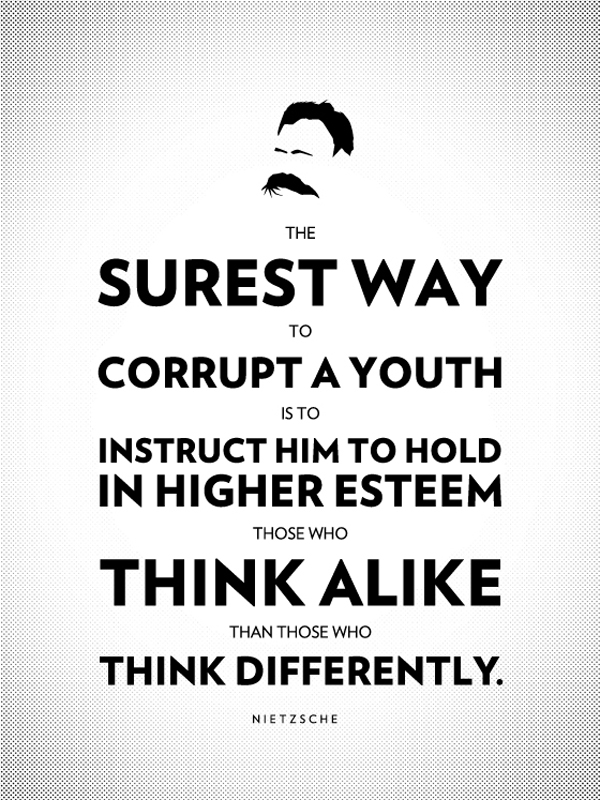
Profound wisdom is something many of us hope we will one day have. But until then, surround yourself with inspiration like this poster series started by Maxistentialism. Another wonderful whim brought to life by Kickstarter. Hooray for the internet!
(via)

