ReWrite Oakland: Real Collaborative Results

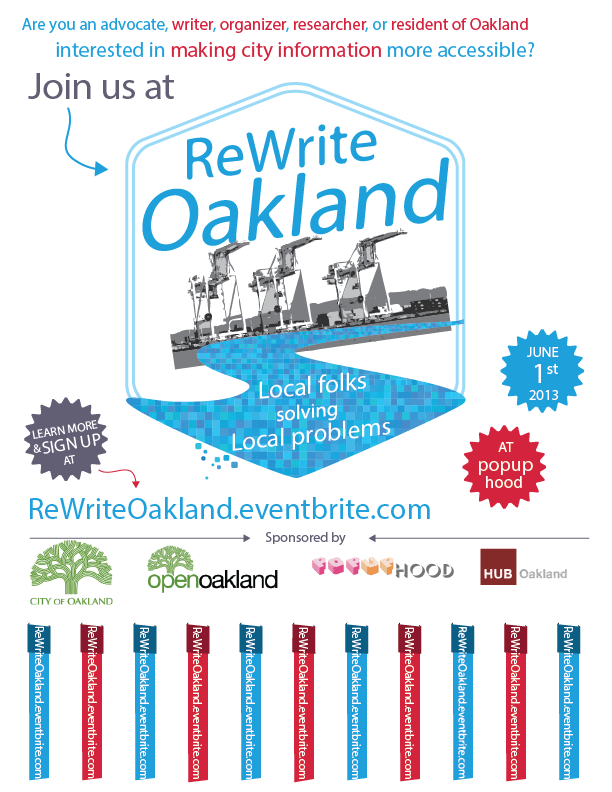
It’s the close of a great day for the 70+ people who gathered at Oakland’s Popuphood HQ in Frank Ogawa Plaza, we have much to show and much still to do, and we’ve learned some valuable lessons throughout the day.

And I’m writing this while Pi begins to play, reminding me that I do love and miss breakbeat dance music. Sidetrack.

Today was a refreshing example of genuine collaboration between a city and it’s people, along with an example of how events can surprise you. As part of the National Day of Civic Hacking (not this one), OpenOakland, Code for America and the City of Oakland hosted a writathon- not a hackathon- we always gotta do things different in Oaktown right!  We based this event on a prototype in Honolulu that we thought was very relevant to our needs in Oakland, open source doesn’t just apply to software, we can share our ideas, events as easily.   The task was to build a new website for our city that gave people easy to find answers to the common questions people have for city government.

And we did it. In one day. Bam. A new question and answer resource for all of Oakland. Presenting the beta version of Oakland Answers: http://answers.oaklandnet.com

Caveat- all the answers live now need to be vetted by city staff- this is all draft content!

So what? Try it. Treat it like google rather than a normal city website. Type in a keyword or your questions and we’ll give you back the best answer possible. That’s the idea. No searching department pages, scanning through PDFs or clicking in vain hope. We think you’ll appreciate it next time you need to find out something about the city.

So that’s a great achievement for 70 people who volunteered for the day, for the twenty or so city staff who joined in, but that’s not the best part. The best result from today is the fact that we built something as a city together– city staff helping, contributing and writing content alongside librarians, tech developers, designers, retirees and advocates.  This is what we’re working towards at OpenOakland- a city that slowly becomes more open to collaboration, open to deeper engagement and open to new ways of building and acquiring technology.

Yes we could built a new website in a hack day of independent developers, but what would be the outcome? What would it change? We need the support and buy-in from the city itself to build new tools together, and we got that support in a big way, so those of us from OpenOakland owe a big debt of thanks to Nicole Neditch who did a ton of heavy lifting to prepare for this event.  With the city being willing to be slightly more open (and yes, that means more vulnerable, and that’s not easy), we were able to leverage the ‘long tail of government’ – the experience, insights and expertise of our whole community.  We don’t underestimate the discomfort of others wanting to be more involved in city business- the human emotion of city staff that reacts to others suggesting that city websites need to be better- we all hate others downplaying our work, but today is not abut that at all.  We took advantage of the good work and example of others (Honolulu) and applied it in our local context to make something awesome and new.

While we were all at work defining questions the residents of Oakland gave us we realized there were some important opportunities that this new resource provided.  Giving the broader community write access to a city website for one day is a new endeavor- safe enough with a pre-beta site, but many people raised the idea that this would be a great tool for people to contribute too over time- in different settings, as things are happening across the city.  That seems like an obvious and excellent idea- whenever you try to access something perhaps difficult to find or complex to understand, or even simple but helpful, you can add a new question and answer to the system- share what you learn when you learn it.  Of course the city gets to review these new entries and approve or improve them, but this is a fantastic upgrade of the ‘one day to contribute’ model we adopted today.

Attending a community meeting and discover something useful about the city, its services or processes? Sign in and suggest a new solution!

For a city to offer its residents a way to collectively build on a community resource like this is pretty new, and it’s a good start to building trust and relationships with a community that has not generally felt trust in its government.  I’m grateful to all the people who came to join us today, to the great developers who did the behind the scenes work (Eddie, Nicole) and to the disruptors at Code for America (Tim, Jen, Cris, Sheila) who inspire and support us at OpenOakland!

At the end of the day, the national campaign is nice publicity, but at the ground level, in our cities, that is where America is changing!

Upping the numbers game in Oakland PD

There is a lot of public pressure and public expectation in Oakland these days as a result of the increased oversight and monitoring of our police department.  The public has been promised much in the way of reforms, better service, smarter policing, something about community policing (but noone is quite sure what that means), better management (by having multiple people in charge presumably?) and a safer city overall.  All the high powered, well compensated experts and consultants in town come with varied baggage and success and all have something important to offer this city.  There is one thing that does seem to unify them all (Frazier, Wasserman, Bratton): data. They all talk up the importance of having and using good data. Data to drive geographic policing or hotspot policing, data for investigations, data for tracking processes and data to spot trends and patterns.

We’ve had some version of the popular model of CompStat in Oakland for a few years now, Batts implemented it when we were still contracting for him to do crime analysis.  Every city does it differently, as they should, and every city understands it slightly differently.  If you still see that word and think it means a computer system or program then please consider yourself corrected- it’s not a program, a piece of software, despite its name. It’s a method, a process. You could do it with pen and paper if you were a genius. Most of us prefer computers however. When things get tight in any city or company you have two options commonly considered- do much less, or try to be smarter and do more with less. Sure there are other options, but this is a blog, not a PhD.  With ~635 sworn officers Oakland has to get smarter. CompStat approaches can help but they are not THE answer. (Given this post was drafted a week ago, new today from Bratton’s report is important context for this: “The city’s Compstat process was more of a "presentation by a captain than a system of vigorous strategic oversight.”“ Source)

There is a fascinating battle raging (perhaps that’s overdramatic- but it’s saturday and I have a good beer open), between some respected academics overtheir opinions/statements on the validity of things like the actual impact of CompStat and other policing strategies, especially from NYCPD. New York is a favorite because of the huge size and corresponding huge samples in data availability, it’s massive drop in crime counts over 20 years and it’s scandals and successes.

When we move to a model where our police department is truly/heavily data driven (no I do not believe it is this way currently) we must be aware of the good and the bad of this approach, and more importantly be aware of the ways this approach can be abused.  Trust in police in Oakland is incredibly low and this is sad, wrong, broken, disgusting etc etc. On all angles. There is much to do to repair this and I propose that we must, it’s not an ok thing to maintain the status quo here.  But with more numbers involved, better reporting and better analysis and communication of these data (that’s the plan right?) comes an increase in the types of activities that have sullied new York City’s reputation and cast valid doubts over the veracity of the crime reduction facts touted there.

Whenever there is a major change in policy or practice we should, as a smart society, be evaluating the impact of these changes. Better sign-up process for food stamps online? You should see an uptake in enrollment – if not you’re missing something. That kind of simple evaluation.  Change the police reporting for multiple types of basic crimes including burglaries so people can only report them online now and no officer will show? You should be providing solid numbers to the public and the city administration on the trends in all those crimes as well as numbers on closure and conviction for those crimes. Things don’t stop at a report- if your reports go up, are you finding more people, less, no change? Any answer means something and should be critically be considered to see what it tells us.

When OPD ramps up it’s technology (Oh God let it be soon) and data use and builds its capacity for dynamic use of CompStat methods we will need to be ever more vigilant of the types of manipulation that have been documented in New York City.  Eterno & Silverman have a book in print that does a stunning job of documenting the abuses of the NYCPD to manipulate the numbers used in the CompStat program, it’s expensive, sorry.  It provides what to me are the most comprehensive and broad analytical assessments of the claims of crime reduction in New York City and shows them to be fraudulent and false overall.  Knowing the kinds of improbable realities they describe should position Oakland’s city staff and our community well to judge if these things begin to occur in Oakland.  For example, if we hear claims of reduction in assaults by 50%, yet our hospitalization reports increase by 90% we should be asking what the hell is going on.  Crime data are in my experience the most manipulated and most misleading figures in common use. Pressure from senior officers to suppress major crime statistics is something that will erode the remaining trust in OPD and will not have a positive impact on crime and violence prevention in our city.

If you want to see more of the critique of Zimring’s ideas that are quite relevant to Oakland check out this brief -then buy the book 😉

http://clcjbooks.rutgers.edu/books/crime_numbers_game.html

In our backyard. Girls as young as 10 are kidnapped, raped, abused, beaten and enslaved to serve the needs of evil men in our community. Yet there is no outrage.  OPD alone cannot fix this. Join us to rid our city and country of human…

Opening Oakland’s Budget

Today a group of Oakland’s civic hackers (the good guys) launched a powerful and simple new tool into the newly announced city budget debate: OpenBudgetOakland.org is an app that allows you to easily dive into different allocations and departments to see just where all the money goes! It’s rad, seriously, it’s something every single resident will be able to learn something new from and almost certainly will raise a few eyebrows about how our city is doing.  The team who built this, primarily Shawn McDougal and Adam Stiles did a fantastic job of also building in a conversation feature that allows users to ask questions and to discuss every single line item of the city budget- the new one proposed today and the past one. And not a single ugly PDF in sight, just clear web graphics you can understand!

It’s a great demonstration of how open data (easily accessible public records), civic hacking (building solutions to city issues fast & cheap) and engaged citizens all fit together to create something awesome.  The team and some of OpenOakland’s other members worked hard to complete the app and launch it in time for the Mayor’s press conference today that would announce the new budget proposal for 2013-2015.  We had hoped the city would publish the new budget data earlier this week but no luck.  Then around noon today the city did some great work to actually get the new budget numbers published on their data site, creating a frenzy of coding and data processing as this team actually built the new visualization tools for the proposed budget and had it live and tested in about six hours. 6. I’m impressed. I hope you are too.  So in a single day the new budget is announced and we already have a great platform to explore the budget nuances, to discuss the implications and to ask informed questions and to share knowledge for those who really know this finance game.

I’m particularly excited about this launch as the Open Budget Oakland team are the first group/app to be accepted into OpenOakland as a formally supported project.  We’ve been deliberating for a few months on how city staff, citizens and developers can come up with a new idea or a new app and have it become part of our official set of projects, and now we have that process nailed down (to be published this weekend!).

In small part this successful launch illustrates a major reason behind the creation of OpenOakland: sustaining civic hacking. Not just as a single project like this, but as a community.  This app was first conceived by Shawn McDougal at the 2012 Code for Oakland community hackathon and was brought to prototype stage on the day despite massive data issues. They even won the grand prize.  Both I and Eddie Tejeda realized there needed to be a place and a community to sustain and to support great projects like this, hence our weekly free hack night in City Hall.  The Hack the Budget team (round 1 name) enlisted great support from the city Budget Advisory Committee to help make the app usable and accurate and it seemed from the sidelines that a stable place to meet and work on civic projects was important for this group.

When the app was almost ready to launch and we had our project submission process finished we were thrilled to have this team apply to be a supported part of OpenOakland- so we now have another great tool in our stack of open government apps in Oakland!  OpenBudgetOakland.org is now a tool were going to support as a Code for America Brigade- and we’re hoping you have ideas also about how this great tool can be even better! share them with us on the site after you’ve explored it…