OpenOakland 1.5: A year and a half in review

As we close out the year, I wanted to reflect on a few things to put our work in perspective and also to lay out the vision for where we want to go in the new year. 2013 was a great year for civic innovation in Oakland. It was a great year for the growing movement to open up government and to build towards a future where our local government is truly by the people, for the people and of the people in the 21st century. But we still have much to do and much to learn. I’m excited about both of those realities.

OpenOakland was created to fulfill two main goals- to provide a backbone level of support for civic innovation in Oakland, and to support our local government in being more open, more agile and more engaged. Both Eddie Tejeda and I believe that the approach taken by Code for America is perhaps the strongest, smartest way to achieve truly open government in the USA and we’re proud to be part of a national movement to transform how government works and is how we as citizens and residents interact with government.

We believe that leadership is best done through supporting others to change, by providing a vision of what could be and by helping others move along that path. OpenOakland was our idea to make that vision a reality and so far hundreds of people across Oakland have been inspired to be part of that journey too- we all want our government to be great- we want to have a positive, trusting relationship with our City Hall and the people working inside. It seems that our approach is yielding fruit in a very small period of time.

We are often perceived as simply technologists who are interested in the technical solution. While many of our members are technically gifted, we are not about the technology- the advantage that technologists offer however is the ability to know what is possible. Take this year’s acclaimed app built by Adam Stiles and Shawn McDougal with support from the city’s Budget Advisory Committee and others: OpenBudgetOakland.org. This app demonstrates so much of what we’re building. Conceived at a hackathon, we offered to help incubate and support the completion of this game changing app. It required the city to release the raw budget in a raw data format for the first time ever- a serious change in attitude from a city hall frequently seen as closed and uncooperative. In releasing this data, the city enabled the development of an incredibly powerful application that would never have been conceived of nor built in city hall. Our team has learned a lot through the launch of this app and has been largely responsible for the increased focus on the city’s budgeting process and the push for increased transparency and engagement in future budget preparation. We’ve helped to change city policy, empower people to ask informed questions and enriched the discussion with trustworthy information. And we’ve helped open the budget data for the first time.

This is what we’re about- technology to change behaviors and to create new possibilities.

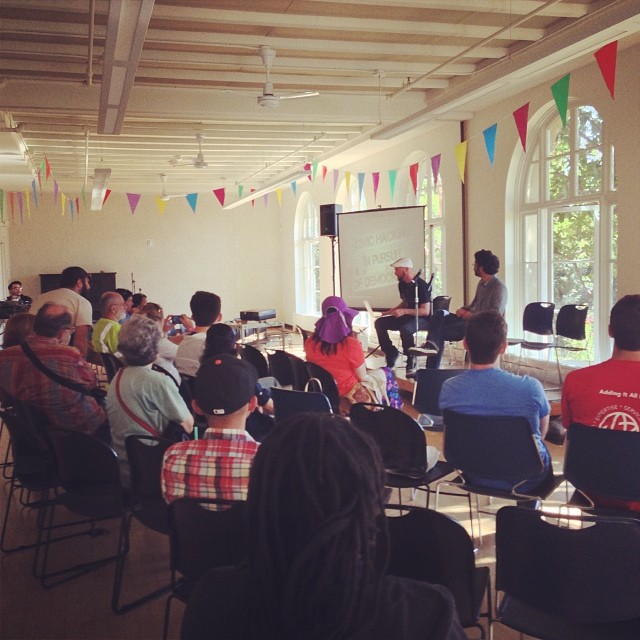
In June we participated in a national event called the National Day of Civic Hacking, co-sponsored by the White House. While other cities were hacking on new apps, we knew there was an opportunity to do something different in Oakland. An app and an idea struck us as being perfectly suited to Oakland- something called Honolulu Answers. It was built by a Code for America team and it consisted of an app and an approach. This app was, like all of our work, Open Source. That means anyone in the world can take the raw code and reuse it however they like. Likewise, the team shared their method to build it. In Oakland, we held an event called ReWrite Oakland- while a geeky play on words, we wanted to build this new web app for our city and we invited the city to participate in building it. Seventy people joined us at the HUB Oakland to create a new resource for all of our city: Answers.Oaklandnet.com was the result. What we did was more than just build a new web app in collaboration with the city- we showed that how the city acquires and considers technology can be different, better, smarter. An open source app and a ton of residents time created a website far more accessible to regular people than the city’s current site. We will be holding ReWrite evenings across the city in 2014, giving more Oaklanders the chance to help build something together.

As this article gets published, we’ll also be launching a new app built with a city project in mind. AdoptaDrainOakland.com was a suggestion form the city’s environmental services team- they saw the success of the Adopta apps used in other cities and asked us to help bring that app to Oakland. The result is another open source website that helps Oaklanders contribute in a small but meaningful way to their city. If we can help to clear out blocked drains when it floods, our public works crews can stay focused on fixing all those potholes we love to hate.

We’ve also been hard at work on building an app that breaks down the old barriers between city council and the public- the dreaded Council agenda PDF nightmare. Led by Miguel Vargas, this app allows regular people to easily find information about discussions and topics hitting council and other meetings in the city. It will allow people for the first time to stay on top of matters that relate to them, without the painful process of digging through dozens of lengthy PDF documents. Our hope is that this makes our council more open and with solid outreach on our part, changes the way people choose to be passive consumers or engaged citizens.

With our community we’ve also built some simple apps, based on other great open source projects in other cities, that help residents find services and connect to their local networks:
EarlyOakland.com helps parents find free early childhood education and care
OaklandBeats.com lets easily people find their local Neighborhood Crime Prevention Council.

We also continue to provide technical support for the amazing OaklandWiki.org project- your very own wiki for the Town! One of our first projects, this has spun off into a dynamic community and is a great resource to share what you know about your city.

Late this year we also participated in the first ever crowd sourced legislation in the City of Oakland. Lauded by the Sunlight Foundation as a promising practice for other cities to follow, we joined dozens of people from across the city and the country to help form the strongest possible new language for the City’s Open Data Resolution, which passed the City Council with no dissension. This new resolution requires our city to develop a comprehensive plan to build out the open data efforts across all departments. Providing a strong sustaining force to the efforts underway already (which we successfully pushed for in 2012 also), this will set our city on a strong path for the future where researchers, developers, analysts and even city staff have simple, legal access to the valuable data the city produces already. We see this as an important factor in changing the status quo regarding staff and electeds attitudes towards transparency- when the expectations for city information becomes “open by default”, our leaders will be operating on a very different platform than in the past.

As with our Open Government Pledge in 2012, we will once again be taking up the challenge to convince our next round of city leaders to support the concept of Open Government. We aim to hold a mayoral candidates forum focused on issues of technology, transparency, engagement and procurement.

Clearly what we’re doing is geeky and optimistic. We think this work matters to the entire city and we’ll be making a lot of effort to connect with organizations and people across this great city in 2014. While our focus has been on building relationships with and changing how things are done inside city hall, we almost forgot that “by the people” is bigger than just those who take the time to join us in city hall for our hack nights and other events. When we formed, we established values of engagement with our city and diversity in our membership and leaders. 2014 presents us with the chance to engage more widely and to share this vision with those who want to participate.  While the technology sector is often an exclusive space, we will be putting in hard work to create a truly inclusive movement in Oakland.

Although not the work of OpenOakland itself, it would be remiss to not mention the powerful new public records system that our Code for America fellowship team built- available now at records.oaklandnet.com, this system provides both a streamlined way for the city to manage and respond to public records requests, it also provides the public with an incredible view into what is being requested. Again this demonstrates how we think- interfaces to government should be designed for the users, should be beautiful and easy to use, should serve the business needs of city staff and should provide an open view for the public.

What has this cost? The simple answer is that all this has been accomplished by an organization with no budget (besides the pizza fund Code for America provides- and that is important) and no staff. Our work has been produced by people with a desire to see our city become stronger, smarter and more open. As leaders of this group, we’ve tried to support as many people as possible in doing things that brings innovation to city hall and creates more beautiful, accessible ways for people to interact and engage with our government. Our events have relied on generous sponsors, but other than their support, OpenOakland to date represents what is possible when people who love their city get together, collaborate and innovate for the good of all.

We need to trust in government again, we need to respect public service, we need a government that is open and serves all people equitably and justly. We also need our government to be able to innovate, to take measured risks and to provide better ways for residents to interact with officials and elected members. This is what we’re about.

We’re excited about what 2014 has in store, and we welcome your feedback on our efforts as well as your partnership to make this vision a reality.
Oakland Planning, data and engagement

There’s a frustrating but worthwhile read over at sf.streetsblog on the city’s decision to close down part of the Latham Sqaure pilot in downtown Oakland. The pilot was meant to last for six months and is being partly shelved after just six weeks. This is another sad example of bad use of data, closed decision making and poor engagement in our city.

Problem # 1:

Planning Director Rachel Flynn, when asked for data on Latham Square’s use, said, “We don’t know how to measure pedestrian and bicycle activity.”

This is 2013 and with the powers of Google at our fingertips (yes, despite the clunky computers in city hall they still can get on to the internets). There are two stupidly simple options should this have been something our city staff actually wanted to do- to understand the problem or the situation. We could have worked with local hackers to build simple, cheap sensors using Raspberry Pi devices and off the shelf sensors- read how here. Or we could have simply paid for a small pilot using the super clever MotionLoft system built in SF that is aimed at helping retail businesses understand pedestrian flow and patterns.

No data is not a situation that is acceptable in this century.  No data simply suggests we don’t care enough to gather it. It says that facts are not really what matter, it’s all about perception and personal opinion. No data cannot be adequately challenged or debated. Data are not everything, but no data are dangerous.

Problem #2:

When you hear an official say something like “we were kind of hearing the same thing over and over” you should be skeptical. Especially when you have people representing significantly sized local organizations stating that they have heard almost nothing but differing opinions to those proffered by city staff.  This problem breaks down into two sub-issues. Firstly, the type of engagement common in our planning dept and the city in general- a couple of town hall meetings which tend to attract squeaky wheels who are in opposition to most projects and are only scheduled to suit a small percentage of the community.  In person alone is not a sufficient form of engagement given how digital our community largely is.  Secondly, there is little opportunity to really test this statement- the meetings don’t have nicely recorded videos to replay the conversations and oppositions and the city is not maintaining an online discussion on the pros and cons of this project. We have no record of these complaints within easy reach.

So what?

It’s disappointing that in a city that desperately lacks any innovation or experimentation, we cancel one of the few creative place based projects so fast.  When the rationale to end the project is that it was "prompted by negative feedback… What we’ve heard from property owners and businesses is they need that access” for cars, it’s hard not to wonder if that is the best approach to civic decision making.

Almost no project or idea in Oakland goes without its critics- if we shut down every experiment to improve our city with no data to objectively measure the impact and if we continue to fail to leverage online communities for ideation and constructive feedback, we are doomed to remain a city under-invested in itself and its future.

If you love the current (well, former) plaza, you can sign the WOBO petition.

Does the world really need another PDF report?

If you’re in government or academia you have surely seen reports that sit on shelves and do nothing once they’ve been compiled. You may even have helped to produce them. They often cost a lot yet yield very little.  At the other end of the information delivery spectrum are powerful, dynamically adjustable web dashboards and interfaces that can often be adapted as needed, but those don’t give us recommendations nor allow us to answer deeper questions.  Often what is really needed lies somewhere in between.

Consider your normal report deliverable – a PDF.  Perhaps you get to provide input for a round of error checking and review once it’s completed, otherwise your only gain as a client is a static document.

Quite often once a consultants report is delivered we realize we should have asked different questions, required more detail in certain areas and more context behind certain explanations, and maybe some things were just not relevant in the end. By then we’re stuck with what we paid for, useful or not.  The fact that it’s 2013 and we’re still thinking in static deliverables and ‘final’ anythings should be astonishing. How can we be smarter about data?

1. Don’t ask for a report.  This assumes that you know everything you will need to know up front, which is often false.  A static report cannot adapt when you realize you asked the wrong question, when you need to dig deeper into a single issue or data set.

2.  Evolve. Consider the flow of information needed for a community planning process- a single dense report up front is simply a huge chunk of information that most people will ignore and most cannot absorb. Ask for data vignets or factsheets on certain aspects that can be delivered along the process timeline to meet needs as they evolve. As your understanding of data needs changes along a process, your data team must be there to support you at each stage.

3.  Don’t silo or isolate your data folks –read more

4.  Iterate. Instead of final delivery and review, adopt a more collaborative approach with your data team. Sit down and brainstorm the direction and details as they form. Waiting for the final version means you’re stuck with it.  You often discover that you need to dig deeper with a specific indicator, or that you need to dis-aggregate to get to the real important stuff. This can’t happen at the end of a report process. Require your staff or consultants to plan for and provide multi-stage reviews. This way the data geeks can get strong guidance from you, and you can better understand the process of getting and analyzing data.

5.  Own your data. or better yet, open your data.  When you pay for a report you get just that, pages, in a PDF.  As we encourage more government agencies to open their data for use by all, we need to do the same in our sector.  When you contract for a report or research support, require the real data to come with it. That way you’re not locked into using the data just how the consultant prepares it; you can manipulate it any way you need.  If you’re a nonprofit or a government agency, you should be considering opening the data for public use. You’ve paid for it, the hard work is done, now you can provide an amazing resource to your community and your stakeholders by publishing the data unearthed in your project.  Data is the ultimate non-consumable resource!  If you’ve gotten government data for your work, put it out there and make it available for others to benefit from also. We work in a far too siloed sector. Why should ten local organizations have to expend the same resources to find the same data? When government data is ubiquitous and easy to find, our work is better, smarter, cheaper.

We need to change how we think about information and about informed processes. We need to be able to learn constantly and to refine our knowledge over time. Static reports don’t allow us to do that.  It’s time we wise up about what to ask for and when to ask for it.  At the very least we need to be asking: “what is the actual value we get from one more PDF report?”.

Planning Camp hits Oakland

What is Planning Camp and why should you be there? It’s an unconference exploring urban planning, technology, and social change. It will be fun, inclusive and engaging!

Urban Strategies Council and OpenPlans are excited to bring PlanningCamp to Oakland and the East Bay!  Be there on October 12th (yes this Saturday!) if you’re working at the intersection of technology and the hard effort of making better cities – on the technology side, or the planning side, or a bit of both.

To be held at Laney College, this one day unconference is a conference where sessions are programmed and led by the attendees. Unconferences are popular in the tech world because they reflect the culture of the industry – hands-on, flexible, a little casual but very hard working. All the sessions are open for attendees to define, describe, and lead. You’ll find the format to be energizing and entertaining.

Join us and spend a day in sessions led by your peers, exploring new and old challenges. Whether you’re thinking about the role technology in public involvement, increasing equity, modeling, analysis, community organizing, at local to regional scales, PlanningCamp will be an opportunity to go deep into conversations and form new connections.

Here are a few of the sessions form the NYC PlanningCamp to whet your appetite:

  • NACTO urban street design guide: How do we change the DNA of city streets?

  • Gentrification of the waterfront after Sandy in Nook.

  • Digital Deserts (infrastructure + adoption + literacy)

  • Participatory Budgeting: how can we keep the bad ideas out?

  • How can technology build social capital and economic opportunities for low income communities? (brainstorm)

  • Lost in Translation—>tools to increase participation among immigrant communities

  • Carshare & self driving cars: How do we repurpose the street?

  • Measuring the Quality of Bicycle Infrastructure.

PlanningCamp Bay Area will take place at Laney College in the Forum Building, close
to E 10th St. We’re just a block away from the Lake Merritt BART, close to AC Transit bus lines, and totally accessible by bike.

Keawakapu beach misty tide on Flickr.

After almost 10 months of waiting to process this series, I’ve finally published what turned out to be my favorite landscape image of the past 12 months, hope you enjoy it also. If you love it enough to want it, it will be available as a fine art print in large sizes and also in modern canvas prints starting at 20×30 inches.

The incredible agency of #opendata

The way we phrase our conceptions is both a simple thing and a complex, layered thing. I’m spending today at CITRIS for a conference of leaders, practitioners and vendors focused on the topic of:

Can “Open Data” Improve Democratic Governance?

This questions is proposed frequently amongst the circles pushing for open data from our governments. But I think we’re making a mistake at the outset, we’re assigning agency to a lifeless, purely digital concept. We need to be smarter than this.

Can Open Data do anything, let alone improve democratic governance?

Hell No.

Open Data can not do anything as it’s just data, numbers, whatever, sitting lifelessly on a sever in the magical cloud somewhere.

What is actually important here? It’s in OPENING data that we do things. What is important is that governments and agencies actually OPEN their data. That act, possible through the agency of the government officials (real people who can make this decision) is what can improve democratic governance.

Let’s not get caught up in vendor speak that some inanimate thing can actually do anything. People need to open their data, and other people must animate and utilize it.

So yes, Opening Data can do much.

Scale and demand

Reading a piece on the Detroit Assessors efforts to reassess every property in the city really struck me – I don’t think this is at all unique to Detroit either, but the scale of effort required by our laws and necessary in order to support a productive, fair urban society is seriously out of wack with our local governments abilities.

Horhn said the city has 11 assessors for nearly 386,000 parcels. That’s 35,000 parcels per assessor, nearly nine times the state recommendation of 4,000.

We have a legacy of heavy state, federal and local legislation that requires different agencies to carry out specific tasks, but over time those requirements have evolved, grown (sometimes ended too) yet the funding for many agencies has not grown with the ask.  Short of some incredible and super reliable innovation, there is no way on earth that this assessors workforce can ever meet their mandate. This is one more case of the requirements never being met and the result is obviously not good for the city of Detroit.  As government slowly becomes more open, more such situations will be discovered, forcing us to ask more difficult questions about the way we do things, the expectations and the layered regulations that impact us on the local level.

Somewhat like the issues Oakland faces with a heavily reduced police force (in large part budget related) and increasing crime. There’s no way to do this without being smarter, much smarter. I’m not going to suggest that technology is the solution, but I’m sure that there are smarter ways to do things that do use technology, people and processes better!

STORY